Friday, March 1, 2013

DAY 17, March 4 - More Theories on the Supreme Being


"If only God would give me some clear sign! Like making a large deposit in my name in a Swiss bank."
Woody Allen (1935 -present)


Michelangelo's "Genesis" in the Sistine Chapel
Perhaps one of Christianity's most famous
depictions, Michelangelo's Genesis
is not devoid of philosophical intent.

Notice the fingers between God and Adam.
Though close, they aren't touching.

Is God destined to be just out of reach? Or is it the opposite?
enrichment icon After defining God, believing in God has been another philosophical hurdle for people in various cultures throughout history. Take a moment to play this game. Given its philosophical (not religious) perspective, you might be surprised by the results! Click here to go to the Battle Ground God game.

Arguments for God's Existence

In the last activity you leaned about two key arguments for God's existence. In this activity, you will examine the remaining two:
ArgumentPhilosopher(s)
CosmologicalPlato and Aristotle
OntologicalSt. Anselm
TeleologicalThomas Aquinas
Mind-BodyDescartes, Spinoza, Leibniz

3. Teleological

Can you conceive of God as a watchmaker?
If you can, then you already understand the essence of the teleological argument. That is, imagine this scenario:


Innards of a watch
You are walking in a pristine forest when suddenly you
come across an elegant pocket watch. Given its detail
and intricacy, would you ever doubt that someone
made it?

The Watchmaker argument follows the same reasoning:
the universe is so complex that it requires a 'maker'
in order to make sense of its own existence. In other
words, there is no way that the universe could have
been created by chance and not design.

Or, in G.K. Chesterton's paradoxical prose, "So one elephant having a trunk was odd; but all elephants having trunks looked like a plot." (Orthodoxy, by G.K. Chesterton. Kessinger Publishing, 2004. p 41)


Carlo Crivelli's "The Demindoff Altarpiece featuring St. Thomas Aquinas
Thomas Aquinas explained the idea in his Summa Theologica:

"The fifth way is taken from the governance of the world. We see that things which lack knowledge, such as natural bodies, act for an end, and this is evident from their acting always, or nearly always, in the same way, so as to obtain the best result. Hence it is plain that they achieve their end, not fortuitously, but designedly. Now whatever lacks knowledge cannot move towards an end, unless it be directed by some being endowed with knowledge and intelligence; as the arrow is directed by the archer. Therefore, some intelligent being exists by whom all natural things are directed to their end; and this being we call God."(The Summa Theologica of St. Thomas Aquinas Second and Revised Edition, 1920)
Scientific View
The teleological argument also receives some scientific support. Systematically, scientists have found that the universe is more complex than they initial hypothesized. Whether this complexity comes from dark energy or singularities, the fact remains that no scientific theory yet has an explanation for how the universe came into existence. In fact, due to the way the universe formed, no matter how powerful our telescopes become, humans will never be able to peer into the universe's first moments. Indeed, even Einstein argued for God's existence.


A star's inner shell
Likewise, you yourself are a part of the universe - star stuff. That is, the atoms in your body were created (could only be created) and released upon the supernova exposition of dying stars. In a very literal sense, these explosions seeded the universe with the atoms necessary for life to develop and planets to form. In other words, every part of your body originated in a star.

Talk about recycling!
Anthropic Principle


A six-story card castle made from playing cards
Almost daily you hear how fragile our world's environment is. But have you ever wondered about the universe's stability?

The anthropic principle argues that humanity's existence is so unlikely, that our being here suggests a creator. Like a deck of cards, if one single piece is removed or changed, the entire structure falls to pieces.

For example, conditions for something as fundamental as the atom depend on a balance of forces to within one in 1018. And without atoms, no physical matter could exist.
Counterarguments
Q.  As a critical thinker, can you spot any problems with Aquinas and/or others' arguments stated above in explaining the existence of God?
A.  After pondering the question, click here for some examples that help answer the question.

4. Mind-Body Problem


Descartes' illustration of the mind body problem
As you learned previously, philosophers disagree as to how and whether the mind and body interact. After all, when you think about it, how can they (unless you believed in idealism or materialism) since the images you "see" are mere representations decoded and sent electrically from your eyes to your brain? And what about insects and animals perceiving the same thing differently?

Since this perceptual filter always exists, how is it ever possible to REALLY know something for certain?
Well, one answer is God. Basically, God acts as a conduit through which the mind and body can interact... the invisible glue that bonds them together. Since the mind and body seem to exist, it only makes sense (within this argument) that something must be causing the two to interact. This argument is extensively explored by Leibniz in his "Monadology" as highlighted in the previous Activity - Is There a God Part 1.
Another variation came from Spinoza, who argued that everything is God (he called it Substance), and so there is no mind-body problem since they are both aspects of the same thing. This, in turn, means that everything from you to the glaciers are simply aspects (or attributes) of God.

Counterarguments
Q.  As a critical thinker, can you spot any problems with Leibniz and Spinoza's arguments in explaining the existence of God?
A.  After pondering the question, click here for some examples that help answer the question.


Some Helpful Resources

  1. Teleological Argument
  2. Anthropic Principle
  3. Condensed Monadology
DAY 16 - The Inside Ride

For the three people who were not participating in the Inside Ride this morning this was a work period.


DAY 15 - Is there a God?  The Idea of the Supreme Being


"In the beginning the Universe was created. This has made a lot of people very angry and has been widely regarded as a bad move."
Douglas Adams (1952 - 2001)


Clouds
This image is the first image connected to the Wikipedia online encyclopedia's entry dealing with God and has been identified as one of the finest images in Wikipedia.

Why?

What is it about light streaming from the clouds (heavens) that invokes images of a Creator? Is it the promise of enlightenment? Or is it the mystery hidden behind the clouds?

For philosophers, the goal is to ascend to the clouds, ask the questions and examine the many different answers.

Defining God

What does the word 'God' mean? Obviously, it means different things to different people. As you discovered in the last activity, Eastern philosophers generally see God as a representation of ultimate reality whereas Western philosophers use a more human-like being.
As you know, definitions are the foundation upon which philosophers seek wisdom. A faulty foundation leads to cracks in the argument, which can, in turn, collapse the entire structure.
For philosophers, defining God is almost as difficult as determining whether God exists. However, like a corporate executive needing to know about golf to get ahead, so too do philosophers seem to need to expound about God to be taken seriously. So why not try for yourself? Click here to go to the Do-It-Yourself Deity generator.

Arguments for God's Existence

There are numerous arguments for God's existence. However, the key arguments you will be studying are:
ArgumentPhilosopher(s)
CosmologicalPlato and Aristotle
OntologicalSt. Anselm
TeleologicalThomas Aquinas
Mind-BodyDescartes, Spinoza, Leibniz

1. Cosmological


Plato and Aristotle in Raphael's "School of Athens"
More so than their peers, Plato and Aristotle sought the answers to the Big Questions. Though they often disagreed, one principle philosophy they agreed on was that existence and the universe required a First Cause or Prime Mover.

In short, here is the cosmological argument:

1. Every finite and dependent being has a cause.

2. Nothing finite and dependent can cause itself.

3. A causal chain cannot be of infinite length.

4. Therefore, there must be a first cause; or, there must be something that is not an effect.
In essence, the cosmological argument can be boiled down to cause and effect. Cause and effect is where something earlier causes an effect after, which, in turn, causes another effect, and so on. Causes necessarily must come before effects, or else you are caught in a paradox (more on this later). A common example used is playing pool: the cue ball (cause) hits the eight ball (effect) on a pool table (the universe).

Think of it this way: the universe is a DVD movie and, growing bored, you choose to watch it in reverse. Doing this, eventually you will get to the very beginning. But the first cause for the movie isn't the first scene - it is your decision to put the movie in the player! Aristotle and Plato, then, performed a thought experiment where they mentally rewound the universe to the point where they believed that the only logical answer for the first cause was God.

did you know iconDid you know?


Have you doubted whether thought experiments are useful? Well, you may be interested to know that Plato and Aristotle's First Cause argument accurately illustrates and parallels the scientific Big Bang Theory. Not bad for two philosophers living over 2000 years before telescopes, satellites and computers!
The Big Bang theory states that the universe began as a singularity (a single, infinitely small, infinitely dense point). At the time, the singularity was the ultimate constituent of reality. In fact, it was the only constituent! Not only did the singularity contain all the matter and energy ever to be in the universe, but also it 'contained' both space and time. The singularity didn't explode into space and time. It created space and time! The question, then, becomes: where did the singularity come from?
Interestingly, the Eastern philosophies you learned about could call this singularity 'Nirvana'. After all, isn't it the case that after a long journey, all most people want to do is go home?

Resources Icon Resources

  1. Big Bang: It Sure Was Big!
  2. Big Bang: A Virtual Tour
  3. NOVA Special: Runaway Universe
Counterargument
Q.  As a critical thinker, can you spot any problems with Plato and Aristotle's argument in explaining the existence of God?
A.  After pondering the question, click here for some examples that help answer the question.

2. Ontological

"Come on now little man, get away from your worldly occupations for a while, escape from your tumultuous thoughts. Lay aside your burdensome cares and put off your laborious exertions. Give yourself over to God for a little while, and rest for a while in Him. Enter into the cell of your mind, shut out everything except God and whatever helps you to seek Him once the door is shut. Speak now, my heart, and say to God, 'I seek your face; your face, Lord, I seek.'"
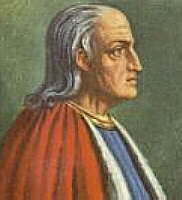
St. Anselm (1033 - 1109)
Another argument for God's existence is the ontological. This argument is favoured by rationalists because it requires no external experimentation or proof - only reasoning. Although it has changed, the original idea put forth by St. Anselm argues that God exists because you can imagine that God exists. Sound confusing?
It isn't really if you can first admit that you aren't perfect (that may be hard but give it a try...).
stop icon Okay, imagine what attributes God must have (don't worry about whether God exists or not, just give it the properties God would need.) So, grab a sheet of paper and make out a list of God's Top Five Qualities.

St. Anselm of Canterbury
Finished? It is a safe bet that perfection is probably near the top of your list. Well, St. Anselm argued that the very fact that you can imagine perfection proves God's existence? How? He used this rationalist argument:
1. It is a conceptual truth (or, so to speak, true by definition) that God is a being than which none greater can be imagined (i.e., the greatest possible being that can be imagined).
2. God exists as an idea in the mind.
3. A being that exists as an idea in the mind and in reality is, other things being equal, greater than a being that exists only as an idea in the mind.
4. Thus, if God exists only as an idea in the mind, then we can imagine something that is greater than God (i.e., a greatest possible being that does exist).
5. But we cannot imagine something that is greater than God (for it is a contradiction to suppose that we can imagine a being greater than the greatest possible being that can be imagined.)
6. Therefore, God exists.
(Taken from the Internet Encyclopaedia of Philosophy)

Below is an excerpt from Anselm's Proslogion:
CHAPTER II
That God Truly Exists 
Therefore, Lord, you who give knowledge of the faith, give me as much knowledge as you know to be fitting for me, because you are as we believe and that which we believe. And indeed we believe you are something greater than which cannot be thought. Or is there no such kind of thing, for "the fool said in his heart, 'there is no God'" (Ps. 13:1, 52:1)? But certainly that same fool, having heard what I just said, "something greater than which cannot be thought," understands what he heard, and what he understands is in his thought, even if he does not think it exists. For it is one thing for something to exist in a person's thought and quite another for the person to think that thing exists. 

For when a painter thinks ahead to what he will paint, he has that picture in his thought, but he does not yet think it exists, because he has not done it yet. Once he has painted it he has it in his thought and thinks it exists because he has done it. Thus even the fool is compelled to grant that something greater than which cannot be thought exists in thought, because he understands what he hears, and whatever is understood exists in thought. And certainly that greater than which cannot be understood cannot exist only in thought, for if it exists only in thought it could also be thought of as existing in reality as well, which is greater. If, therefore, that than which greater cannot be thought exists in thought alone, then that than which greater cannot be thought turns out to be that than which something greater actually can be thought, but that is obviously impossible. Therefore something than which greater cannot be thought undoubtedly exists both in thought and in reality.


CHAPTER III
That God Cannot be Thought Not to Exist 
In fact, it so undoubtedly exists that it cannot be thought of as not existing. For one can think there exists something that cannot be thought of as not existing, and that would be greater than something which can be thought of as not existing. For if that greater than which cannot be thought can be thought of as not existing, then that greater than which cannot be thought is not that greater than which cannot be thought, which does not make sense. Thus that than which nothing can be thought so undoubtedly exists that it cannot even be thought of as not existing. 

And you, Lord God, are this being. You exist so undoubtedly, my Lord God, that you cannot even 
be thought of as not existing. And deservedly, for if some mind could think of something greater 
than you, that creature would rise above the creator and could pass judgment on the creator, which is absurd. And indeed whatever exists except you alone can be thought of as not existing. You alone of all things most truly exists and thus enjoy existence to the fullest degree of all things, because nothing else exists so undoubtedly, and thus everything else enjoys being in a lesser degree. Why therefore did the fool say in his heart "there is no God," since it is so evident to any rational mind that you above all things exist? Why indeed, except precisely because he is stupid and foolish?

This text is part of the Internet Medieval Source Book. The Sourcebook is a collection of public domain and copypermitted texts related to medieval and Byzantine history.

Not convinced? Well, lots of other people weren't either (and more on that later). However, Descartes (remember him? "I think, therefore I am") was. He made the argument more accessible in his Third Meditation contained within his Meditations on First Philosophy. To summarize, God exists for Descartes because if God didn't his entire conception of reality might be false, and God would not do that to someone. If you too have difficulty with this argument, don't worry. Hume felt the same way (more on him below).

 Required Reading
Click here to read Descartes "Third Meditation: Of God: that He Exists". After reading the meditation, reconstruct Descartes' point-by-point argument proving that God exists using no more than 7 points.

Godly House Party Manners
It's rude to go to someone's house party without bringing something (often, but not always, potato salad - that would be an example of a sufficient but not a necessary choice...). So too do philosophers argue that God must have come to the universal picnic with some specific qualities.

The ontological argument suggests four principal qualities that God must necessarily have in order to be God:
  1. All Powerful (Omnipotent)
  2. All Seeing/Knowing (Omniscient)
  3. All Good
  4. Existence
Counterarguments
Q.  As a critical thinker, can you spot any problems with St. Anselm, Descartes and/or others' arguments stated above in explaining the existence of God?
A.  After pondering the question, click here for some examples that help answer the question.
Look back at your list of God's Top Five Qualities. Are they similar or different? If similar, why do you think that is? If different, how would you defend your choices?


A Helpful Resource

  1. Outline of Descartes' Meditations Arguments
DAY 13 & 14- Dolphins as Persons?

Work periods for your Dolphin article assignment - please see the previous blog post for the assignment.


DAY 12 - The Idea of Personhood

Your first marked work is the Metaphysics Critical Thinking Question - here's the Marking Sheet for it as well.

This was a work period for this assignment.


Wednesday, February 20, 2013


DAY 11 Theories of "The Self"  & "Personhood in Virginia"

First of all THANK YOU very much for being the seniors in the school - your help in setting up the class after moving 35 desks back from the caf after the trial Literacy Test today was invaluable, thank you!

Before looking at First Class Travel, let's establish the four big theories of "Self":


Bundle Theory
Who: David Hume

  • the "Bundle" refers to the collection of experiences that you carry around with you forever.
  • the Bundle represents your experiences.
  • It's a loose collection of PERCEPTIONS about your past experiences.

Project Theory
Who: Jean-Paul Sartre

    • the "Project" refers to an ongoing, never-ending project, like the building of a bridge that never ceases.
    • always evolving, your "self" is always changing, it's connected to the past (experiences) and the future.
    • The exact nature of the project that Sartre refers to is connected to the soul, morals, conscious thinking.

    Narrative Theory
    Who: Ricoeur:

      • The image of a "Book" comes to mind, somewhere to write your own story.
      • The main character is created by one's experiences and present events.
      • The story is related to other people too, and everyone's book intermixes.
      • Your story never ends, even after death as your story continues to be written in other people's narratives (books).

      Substance Theory:
      Who: Descartes

      • the "Substance" is a mental substance of the mind, NOT derived from material things.
      • This is the opposite of the Bundle Theory.
      • Experiences do NOT change the self, they only send the self in difference directions.
      • This is analogous to a sail boat, e.g., "the HMS Self" - the wind are experiences that may change the boat's direction in the water but do not change the boat in any way.

      Here's a link to just one of many news stories on the following topic: "Women Rally in Virginia"
      The "Personhood" Bill of Virginia:


      HOUSE BILL NO. 1
      Offered January 11, 2012
      Prefiled November 21, 2011
      A BILL to construe the word "person" under Virginia law, including but not limited to § 8.01-50 of the Code of Virginia, to include unborn children.
      ----------
      Patrons-- Marshall, R.G. and Cline; Senators: Colgan and Garrett
      ----------
      Referred to Committee for Courts of Justice
      ----------

      Be it enacted by the General Assembly of Virginia:
      1.  § 1. The life of each human being begins at conception.

      § 2. Unborn children have protectable interests in life, health, and well-being.

      § 3. The natural parents of unborn children have protectable interests in the life, health, and well-being of their unborn child.

      § 4. The laws of this Commonwealth shall be interpreted and construed to acknowledge on behalf of the unborn child at every stage of development all the rights, privileges, and immunities available to other persons, citizens, and residents of this Commonwealth, subject only to the Constitution of the United States and decisional interpretations thereof by the United States Supreme Court and specific provisions to the contrary in the statutes and constitution of this Commonwealth.

      § 5. As used in this section, the term "unborn children" or "unborn child" shall include any unborn child or children or the offspring of human beings from the moment of conception until birth at every stage of biological development.

      § 6. Nothing in this section shall be interpreted as creating a cause of action against a woman for indirectly harming her unborn child by failing to properly care for herself or by failing to follow any particular program of prenatal care.

      § 7. Nothing in this section shall be interpreted as affecting lawful assisted conception.


      Some great discussion items - 
      1.  Peter Singer: on personhood .....  do you agree with him?  What criteria that he provides to you agree with?
      2.  The other point of view.  Do you more fully agree with this point of view?  What criteria provided to you agree with when designating a person?
      3. Conclusion:  What did Virginia ultimately decide?


      Friday, February 15, 2013

      DAY 9 - Tuesday After Family Day.  Ontology and Such

      Your job for today, in the Library, is to create good notes the information below paying particular attention to the bolded terms.  In many cases you will need to refer to the Internet beyond this blog entry.

      In addition to that, you are to include in your notes the following:

      Who are the main philosophers who adhere to these theories?
      Can you find direct quotes linking them to these theories?
      What links to your life and/or society in general are there (examples).

      Three key terms in ontology are substance, individuals and universals.   Substance refers to the essential reality of something that is independent, unchanging and can exist by itself. For example, in a monist reality (one substance) most philosophers cite God or Being as that substance. In a dualist reality (two substances or more) philosophers generally focus on bodies and minds.

      Individuals are distinct, independent, singular entities (for example, you, a strawberry, a train) whereas universals are separate proprieties of an individual. For example, you are tall but your friend is taller. Tallness, then, is a universal since it can be in multiple places at one time and is used to differentiate individuals. Colour too can be a universal.

      Before Proceeding, take a moment to create a list of 10 other universals. This will be helpful when you begin tackling the "mind/body" problem later in this activity.

      3. Existentialism (or Me, Me, Me!)
      Have you ever thought:
      "How did I get into the world? Why was I not asked about it and why was I not informed of the rules and regulations, but just thrust into the ranks as if I had been bought by a peddling 'shanghaier' of human beings? How did I get involved in this big enterprise called actuality? Why should I be involved? Isn't it a matter of choice? And if I am compelled to be involved, where is the manager-I have something to say about this! Is there no manager? To whom shall I make my complaint?" (Young Man in Kierkegarrd's Repetition)

      If so, you might be an existentialist! Existentialism centres on the idea that "existence precedes essence", which was captured byJean-Paul Sartre. However, existentialism itself was conceived a century earlier by noted philosophers Soren Kierkegaard and Freidrich Nietzsche. .
      Summarizing existentialism is easy: the individual defines reality, often within a hostile and indifferent world. But, as you know from the earlier activities, reducing existentialism to a single sentence is only the tip of the philosophical iceberg.

      Friedrich Nietzsche
      Fred Nietzsche

      4. Nihilism

      After all of that if you are feeling adrift and questioning life's purpose, fear not! In fact, fear nothing as Nietzsche might suggest...

      Nihilism is the "belief" that life has no meaning whatsoever. A nihilist wouldn't argue that life doesn't exist, just that it has no purpose, meaning or universal values. Some might argue that Shakespeare's Macbeth was a nihilist when he lamented "Life's but a walking shadow, a poor player that struts and frets his hour upon the stage and then is heard no more; it is a tale told by an idiot, full of sound and fury, signifying nothing." And further evidence of nihilism in literature can be found in post-1860s Russian literature (Turgenev's Fathers and Sons Dostoevsky's Crime and Punishment) and the Hollywood movies, The Big Lebowski and Fight Club.

      But don't lose all hope. Even Nietzsche noted that "I praise, I do not reproach, [nihilism's] arrival. I believe it is one of the greatest crises, a moment of the deepest self-reflection of humanity. Whether man recovers from it, whether he becomes master of this crisis, is a question of his strength!".  


      Image of a movie poster from the film, The Big Lebowski
      did you know icon Did You Know?Evidence of nihilism in modern day Hollywood films can be found in popular movies.
      The Big Lebowski (1998) is a comedy film that examines a few days in the life of a burned out, unemployed slacker, known as the Dude, who is in the process of allowing life to drift by, when he is mistakenly identified as a millionaire with the same name (Jefferey Lebowski).
      The Dude, who finds himself in the middle of an elaborate kidnapping plot, must repeatedly throughout the film face down a group German nihilists modelled after the band Kraftwerk: "We believe in no-zhing, Lebowski. No-zhing."

      As the movie nears its end, The Dude sums up his situation and philosophy with the phrase, "The Dude abides".

      Image of a movie poster from the film, Fight ClubIn director David Fincher's Fight Club, the film opens with a monotone narrative, as dreary as the life that Jack (the main character) lives. Jack has been taught everything the world tells him is necessary to achieve popular notions of happiness. He has a great job, an upscale apartment, sharp clothes, and an automobile. Yet Jack is not happy. In truth, deep down Jack is fading away and he is helpless to do anything about it. He cannot sleep properly, he doesn't eat, in fact Jack is just an empty shell going through the motions of life. His entire life he has been told by mainstream society what he needs to be happy. Why should he continue to accept these beliefs when they are actually killing him.
      Eventually Jack meets an interesting and twisted character named Tyler Durden, who helps Jack realize that everything is wrong with his life.

      Through Tyler, Jack slowly develops Jack into a nihilist, until he rejects everything he has ever been taught about what is necessary to enjoy a successful and happy life. As you watch the film try to identify the many ways Jack comes to reject pop culture (You are not your job. You are not the money in your bank account. You are not the car you drive. You are not how much money is in your wallet. You are not your clothes). Jack comes to realize all of his possessions only make his life experience empty. Jack now loathes his former 'happy' life. The numbness he once felt with life turns to anger and excitement, which is channeled within "Fight Club", a secret place where confused men meet to do battle as pit fighters. Nihilism brings life to Jack and his band of characters within Fight Club. The obstacles that once plagued him are swept away; he achieves good sleep for the first time in years. Life does not become perfect for Jack, and there are many continuing trials, but by the film's end Jack sees new hope after living a nihilistic life. Consider a trip to your local video store and viewing these acclaimed motion pictures to see how the concept of a nihilistic approach to everyday modern life, is highly feasible.
      "The above images are of posters, and the copyright for them is owned by the publisher and the creator of the work depicted. The use of scaled-down, low-resolution images of movie posters to provide critical commentary on the film, event, etc. in question or of the poster itself, not solely for illustration qualifies as fair use under United States copyright law" (Wikipedia.com.).
      external links icon Resources
      1. Nothingness
      2. The Existential Primer
      3. Jean-Paul Sartre's "Homepage"

      Wednesday, February 13, 2013

      DAY 8 - Rene Descartes


      Cogito Ergo Sum (I think, therefore I am)

      Right now you might feel a little doubtful about, well, everything! If so, don't worry... you aren't alone. Back in 1641 famous modernist philosopher and mathematician Rene Descartes essentially rationalized (thought without experimenting) his way to a very frightening conclusion: he might not exist! Fortunately, Descartes was able to convince himself otherwise and revolutionized the mind-body argument when he wrote his famous Meditations on First Philosophy.

      How did he do this? Actually, he was sort of watching the 16th century version of reality tv; he was sitting in a chair, looking out his window at a man in a trench coat. Because he could not see the man's face, he realized that he had no real proof that the man was in fact a man. He could be something else (perhaps a robot) dressed as a man. This startling conclusion led him to begin a mammoth thought experiment centering on doubt; in essence, what can you really know for certain?
       
      Think of all the certainties that you take for granted: the sun rises, your senses don't (usually) lie to you, family members exist, friends are fun to hang out with, etc. Descartes, however, started doubting all of that, and more. As he himself says in his "First Meditation", "Several years have now elapsed since I first became aware that I had accepted, even from my youth, many false opinions for true, and that consequently what I afterward based on such principles was highly doubtful; and from that time I was convinced of the necessity of undertaking once in my life to rid myself of all the opinions I had adopted, and of commencing anew the work of building from the foundation..." (Réné Descartes, The Method, Meditations and Philosophy of Descartes [1637]).

      In the end, Descartes rationalized away everything from his bathrobe to his body. He just couldn't prove, necessarily, that he wasn't either dreaming or being tricked by some malicious evil spirit. Today we might compare his concerns to being either downloaded into a virtual reality machine (ala the Matrix) or being a brain in a jar being fed false sensory stimuli. And if you think that sounds too sci-fi, just remember the famous "I smell burnt toast!" exclamation from a surprised epilepsy patient whose brain was being electrically stimulated by Doctor Penfield back in the 1930s. Think of it this way: can you prove without any doubt that you are not dreaming, hooked into a computer or a brain in a jar?

      Fortunately, Descartes' doubt was not infinite. He realized that although he could doubt everything from his friends' existence to his own senses, he could not doubt that he was thinking (otherwise, he wouldn't have had that thought). This simple realization allowed Descartes to infer the necessary and sufficient existence of himself ("I think, therefore I am") and time (since memories must be from a time that is not now). This foundation permitted him to later "prove" the existence of the body, senses and even God.

       Required Reading
      For your activity you will be reading the first two Meditations from Descartes' Meditations on First Philosophy. Read an edited version of his first and second chapters below . If you want to read Descartes' entire Meditations on First Philosophy or have a helpful study guide, then check out the Resources section.

      Edited "Meditations on First :Philosophy".


      Pre-Assignment Practice: As you read try to identify the main points in Descartes' writings. Are Descartes' arguments valid? Why or why not? Consider how his arguments might be improved upon.

      EnrichmentBefore continuing, you may want to play a web-based game called "Philosophical Health Check" where you can discover for yourself whether you accept the brain in a jar possibility. Click here to start.

       Resources

      1. Necessary vs. Sufficient Conditions
      2. Concepts of Necessary and Sufficient
      3. Dualism
      4. Aristotle's Metaphysics Summary
      5. Meditations on First Philosophy 
      DAY 7 - Big Questions Review & Einstein

      We did some review of the Big Questions - Personhood, Supreme Being, Nature of Reality/Matter, and we ended up talking about the nature of the universe a la Einstein - see below:

      Space-time curvature

      Does it seem strange that Einstein keeps popping up in a philosophy course? Yet, when you are asking the question 'what is reality?', few people have contributed so much to changing our view of what reality is as he did. Indeed, Einstein's famous equation E=mc2 actually expresses a big philosophical position too; basically, matter and energy are the same thing, but just perceived differently.

      Likewise, Einstein's theory of relativity explains how something as accepted as time isn't always guaranteed. Gravity and velocity can cause time dilations, which means that if you are near something heavy enough or are going fast enough, time slows down for you (this might explain the feeling you get after eating a huge meal or when you're racing to get to the bathroom after a long class!). If you were travelling on a space ship going 0.999999c (where c = speed of light), the journey to Pluto from Earth would only take 42 seconds for the people on the spaceship, but back on Earth over 5 hours would have passed. In essence, you would be travelling into the future! But such concerns are not merely for science fiction; GPS device manufacturers are intimately aware of relativity since ignoring the theory would result in their satellites not functioning.

      The subject of reality grows stranger yet when you consider the recent speculation into String theory. Simply, String theory suggests that the universe as we know it is merely an infinitesimally small part of a series of interwoven, vibrating strings... So, even if reality really is an illusion, the question now becomes: which illusion is it?

      Resources
      Animated Theory of Relativity 
      Animated Time Dilation Calculator 
      String Theory Website

      Tuesday, February 12, 2013

      DAY 6 - Metaphysics Videos

      Today we start in the Library - your job is to find one short video (YouTube) and defines, explains, identifies or otherwise depicts your understanding of Metaphysics thus far.

      Add your link to that video to this Metaphysics Video Form by filling out the form.  You will then present these in class beginning at 9:15 this morning.

      Here are the links you provided - great discussion followed in all sorts of different directions.

      http://www.youtube.com/watch?v=c8YQE69QsL8

      http://www.youtube.com/watch?v=KcivmBojzVk

      http://www.youtube.com/watch?v=wZ82ATRFVrc

      http://youtu.be/ECJO0eSpBAU

      http://www.youtube.com/watch?v=ZWZEuv6pBIE

      http://www.youtube.com/watch?v=4tbHU04RHrU

      http://www.youtube.com/watch?v=DozI0awtPyg

      http://www.youtube.com/watch?v=iO3YBQa6GHM

      http://www.youtube.com/watch?v=ZWZEuv6pBIE

      http://www.youtube.com/watch?v=KcivmBojzVk

      http://www.youtube.com/watch?v=iO3YBQa6GHM

      http://www.youtube.com/watch?v=peRqNZ4Tpm0

      We also had a good look at that image up there - "History of the Universe".  I would think that we cannot consider fully the state of matter unless we think in terms of "all that is" and that's why we spent some time on that image today!


      DAY 5 - Socrates and Reality??


      • Set the standard all subsequent Western philosophy.
      • We depend upon other philosophers for info about him.
      • Sentenced to death for "moral corruption" of Athens' youth - could have argued his way out but chose the high moral road and drank the hemlock anyway.
      • No human knowingly does evil - we always strive to do right.
      • Full time philosopher - used to be a mason.
      • Focused on "moral character" - to understand "virtue", via knowledge.
      • Free discussion is the path to knowledge and virtue.
      • Socratic dialogues - main way he taught.
      • Never accepted payment from his students.


      What is REALITY??  Possible answers include:
      1. The actual state of matter.
      2. "Verity" of a statement - conformity with "fact".
      3. Indisputable truths, e.g. Mathematical principles.
      4. The state of being true.
      5. Honesty, integrity, truthfulness.
      6. Agreement with a standard or original.
      7. Accuracy, as of position or adjustment.
      8. Fidelity or constancy.
      9. In truth, in reality; in fact; actually: e.g. "In truth, moral decay hastened the decline of the Roman Empire."


      Thursday, February 7, 2013

      DAY 4 - Dive into Metaphysics & Socrates!


      Part 1: An Example of How History Has Helped to Shape Philosophical Trends
      Welcome to the Philosophy: Questions and Theories (HZT4U).
      multimedia iconAs an introductory activity you are asked to complete an interactive quiz dealing with your knowledge of modern civilization prior to 1500. There are six multiple choice questions included, and based upon the number of correct answers you accumulate a virtual history prize will be awarded at the conclusion. Following each question you will be shown the correct answer. Pay particularly close attention to the accompanying explanation that follows each answer. It will help to describe how and why aspects of life have changed from the Middle Ages to the modern era, and how this has helped to shape philosophical trends in the modern world.
      Part 2: What is Metaphysics?
      "The unexamined life is not worth living."
      Socrates (469 - 399 BCE)

      Rodins The Thinker statue is of a man sitting in contemplation with a fist on his chin.
      Rodin's "The Thinker"
      Each day you are inundated with information - conversations, signs, television shows, Internet blogs, dreams and more. How often do you actually contemplate this information with the intensity of Rodin's famous statue?
      Probably not all that often. But then, with all of the day-to-day demands, who has the time? Indeed, all of this information is sort of like eating nothing but fast food; you may feel full but are you really satisfied?
      Philosophy (which translates to "love of wisdom") is about taking time to consider, critique and reflect on the big questions. These answers do not come easily, nor are there many absolute answers. However, for many philosophers, the journey is more important than the destination.
      So grab a comfy chair and let's take that first step!

      Metaphysics

      So what is Metaphysics? Well, imagine you and your friends are driving in a car for a good old-fashioned road trip. One of your friends might ask, "Where are we going?", while another wonders, "When will we get there?", while yet another cries out, "Who are we meeting later?" These are important questions, especially for the driver. But imagine your friends' reactions when you suddenly state, "Is this a dream?"
      Assuming they didn't turn the car around, your friends' answers would be metaphysical. That is because Metaphysics asks the really  Big Questions:
      • What is real?
      • What is the meaning of life?
      • What is our place in the universe (if, indeed, there is one)?
      • Does the world exist?
      • What are things really made of?
      • Do we have free will?
      • Does God exist?
      and, importantly,
      • Does any of this matter, and if so, how so?
      As you can see, Metaphysics seeks answer to the same question satirical novelist Douglas Adams answered: what is the answer to life, the universe and everything? However, unlike Adams' tongue-in-cheek answer of
      : the answer to life, the universe and everything, according to Douglas Adams in his series The Hitchhikers Guide to the Galaxy.
      42: the answer to life, the universe and everything, according to novelist Douglas Adams, few philosophers would agree that the answer is so easy.

      I distributed a short history of Socrates and you all made a "top 10 list" of things everyone should know about Socrates.

      Tuesday, February 5, 2013


      Day 3  Philosophy in Pictures

      Please use this link to get to your first assignment, Philosophy in Pictures.  I will also hand out a paper copy.

      We are in the Library Lab to complete this assignment.

      A good source for information about Philosophy is the Stanford University Encyclopedia of   Philosophy.  Check these links out (don't read the entire things, they're involved, just scan and get a feeling for the three areas of Philosophy that we have already discussed in class).

      Metaphysics

      Epistemology

      Ethics


      Monday, February 4, 2013

      Day 2: Questions Asked and Answered

      1.  Review of yesterday's Dennett video and the big questions it raises.  Below here is a sample answer to the question, "Comment on the video."  See?  Simple question, complex answer.
      2.  We continue with the next two videos (see yesterday's post) and addressed the main points of them.

      Some of the discussion that the "Epistemology" video elicited included these ideas:
      1. We are sometimes willing to lie to ourselves (ignore the actual truth)  to make ourselves feel better (raise our self-esteem).
      2. The only honest job is the magician's - she/he tell you that they will deceive you and they do!

      Some of the discussion that the "Ethics" video elicited included these ideas:
      1. The Greater Good Principle" - when deciding upon the Ethics of an issue, does it matter that a greater number of people will benefit?
      2. Although we all agree that generally it is not right to lie, there just might be situations where lying is the ethical thing to do (would you tell the axe-murder where your parents were enabling him to go an hack them?)
      3. Do ethics apply to other living creatures like genetically modified lab animals, animals used for product testing, etc.?

      Video #1: Dan Dennett: Responding to Pastor Rick Warren

      Dan Dennett’s ideas concerning religion and how we must collectively use the study of it to further societal progress are extremely interesting. He states that instating universal education of world religions is the only suitable practice in an advanced, democratic society that will promote generations with an approach to all faucets of life sans religious intolerance and thus, the skepticism and prejudices nurtured by growing up ardently following one religion. In fact, he suggests that what we know as democracy cannot function properly without such an institution.
      Universal education of world religion is indeed an exciting idea. To me, however, it is less plausible of an idea to instate than is presented in the video. I’m not saying Dennett’s idea is bad, in fact, I agree that in all areas of education, children should receive as much unbiased, factual information as they can. This includes math and English and second/third/fourth languages, in history, geography, current events, law, business, etc. The basis of Dennett’s proposal is to provide student s with FACTS about world religions. But on topics so broad and so very polluted with matters of opinion and contradiction, how is it possible to teach general religious lessons on just the facts? And, how is it possible to mediate a respectful discussion where fact versus interpretation within religion can be dissected without offending anyone, or causing serious ideological conflict?
      Not only is there a huge grey space between what is a fact and what is interpretation when looking at religions, today it is an incredible challenge to make any statements concerning the nature of any one religion without risking the anger of its followers. For an international example, Islamic religion dictates that women should be treated differently men in many ways, such as where each gender is allowed to pray in a mosque (for women it is in the back or basement, out of sight) or how a woman is allowed to present herself in public. When international organizations look into primarily Islamic countries and see gender inequalities it is virtually impossible to help women living in unjust and potentially dangerous situations because the issue at hand involves denouncing the morality of another’s religion. In my mind, the terrible abuse women in many Arab countries live with is not a question of religion at all, but of sexism and misogyny. But what rights do I have which allow me to state what is and is not a fact or an unfair interpretation within Islamic tradition… what right does anyone have to do so?  This argument is firmly established around the world and stands between anyone calling on the morality of religion and the validity of their point, regardless of whether it is something concerning human rights, or another cause.  Even in Canada, our unyielding acceptance for multiculturalism has created such a strong vehemence against anyone that disrupts the principal of universal acceptance and tolerance that debating the ethics of someone’s theological beliefs paints the inquisitor as racist, judgmental and hostile. Thus, in our country, it will be the teachers who administer these lessons Dan Dennett calls for that will face ostracism for presenting certain “facts” about religion and that will certainly make enemies while doing so.
      Regardless, Dennett’s point concerning the function of democracy is valid. Our governmental philosophy cannot work properly if our population is not as educated as is possible. Where religion is concerned, many current events occurring within our own borders could perhaps be understood better by Canadians with a formal, multicultural religious education. With this, when public discussion is raised around issues such as abortion and civil rights such as gay rights, less absolute ideologies would bash against one another and more tolerant discussion and debate could be held – and progress reached. Today when one of these issues is raised, the choice you have is to fall in behind one side or the other – with vigor – or to be labeled as an uncaring or uneducated individual. Dennett’s model proposes that the majority of people religiously educated would be able to see for themselves both sides of the argument and then jump right into problem solving. If we could get rid of the challenges surrounding public discussion and debate over the ethics involved with individual religions and positively educate students on the history and practices of these ancient and revered institutions, then our democratic system would certainly have new potential to flourish and progress.

      Friday, February 1, 2013

      DAY 1 Welcome to Philosophy!!


      Day 1: Welcome!

      1.  Why study philosophy?  Matt Groening, creator of the Simpsons, explains.
      2.  You will need to think outside of the box
      3.  Aristotle in Three Minutes!!
      3.  Ideas, people, events, etc ... the A-Z guide to philosophy.
      4.  Your big questions.

      For tonight and tomorrow at school . . . first of all you will NEED a Gmail account for this course - go and make one for yourself if you don't already have one.  Please make it as close to your first and last name as possible - mine is marktkovich@gmail.com.

      Some assignments will be completed using googledocs (presentation, forms etc).

      Everything else will be submitted through D2L (Desire to Learn) - more on that later.

      HOMEWORK:

      1.  Complete this Contact Information Form .

      2.  Watch these three videos (you can see the text of these talks (subtitles) by clicking the button directly below the video indicating "27 Languages"):

      Metaphysics 
      Epistemology
      Ethics

      Write your impressions of each video; what you agreed with, what you question, how the main idea(s) fit in your life.  Be prepared to share and hand in your ideas tomorrow.