Wednesday, February 19, 2014

DAY 12  Theories of "The Self"  & "Personhood in Virginia"


Before looking at First Class Travel, let's establish the four big theories of "Self":

Bundle Theory
Who: David Hume

  • the "Bundle" refers to the collection of experiences that you carry around with you forever.
  • the Bundle represents your experiences.
  • It's a loose collection of PERCEPTIONS about your past experiences.

Project Theory
Who: Jean-Paul Sartre
    • the "Project" refers to an ongoing, never-ending project, like the building of a bridge that never ceases.
    • always evolving, your "self" is always changing, it's connected to the past (experiences) and the future.
    • The exact nature of the project that Sartre refers to is connected to the soul, morals, conscious thinking.

    Narrative Theory
    Who: Ricoeur:
      • The image of a "Book" comes to mind, somewhere to write your own story.
      • The main character is created by one's experiences and present events.
      • The story is related to other people too, and everyone's book intermixes.
      • Your story never ends, even after death as your story continues to be written in other people's narratives (books).

      Substance Theory:
      Who: Descartes
      • the "Substance" is a mental substance of the mind, NOT derived from material things.
      • This is the opposite of the Bundle Theory.
      • Experiences do NOT change the self, they only send the self in difference directions.
      • This is analogous to a sail boat, e.g., "the HMS Self" - the wind are experiences that may change the boat's direction in the water but do not change the boat in any way.

      Here's a link to just one of many news stories on the following topic: "Women Rally in Virginia"
      The "Personhood" Bill of Virginia:
      HOUSE BILL NO. 1
      Offered January 11, 2012
      Prefiled November 21, 2011
      A BILL to construe the word "person" under Virginia law, including but not limited to § 8.01-50 of the Code of Virginia, to include unborn children.
      ----------
      Patrons-- Marshall, R.G. and Cline; Senators: Colgan and Garrett
      ----------
      Referred to Committee for Courts of Justice
      ----------

      Be it enacted by the General Assembly of Virginia:
      1.  § 1. The life of each human being begins at conception.

      § 2. Unborn children have protectable interests in life, health, and well-being.

      § 3. The natural parents of unborn children have protectable interests in the life, health, and well-being of their unborn child.

      § 4. The laws of this Commonwealth shall be interpreted and construed to acknowledge on behalf of the unborn child at every stage of development all the rights, privileges, and immunities available to other persons, citizens, and residents of this Commonwealth, subject only to the Constitution of the United States and decisional interpretations thereof by the United States Supreme Court and specific provisions to the contrary in the statutes and constitution of this Commonwealth.

      § 5. As used in this section, the term "unborn children" or "unborn child" shall include any unborn child or children or the offspring of human beings from the moment of conception until birth at every stage of biological development.

      § 6. Nothing in this section shall be interpreted as creating a cause of action against a woman for indirectly harming her unborn child by failing to properly care for herself or by failing to follow any particular program of prenatal care.

      § 7. Nothing in this section shall be interpreted as affecting lawful assisted conception.


      Some great discussion items - 
      1.  Peter Singer: on personhood .....  do you agree with him?  What criteria that he provides to you agree with?

      2.  The other point of view.  Do you more fully agree with this point of view?  What criteria provided to you agree with when designating a person?

      Tuesday, February 18, 2014

      DAY 11 - Rene Descartes
      Cogito Ergo Sum (I think, therefore I am)
      Right now you might feel a little doubtful about, well, everything! If so, don't worry... you aren't alone. Back in 1641 famous modernist philosopher and mathematician Rene Descartes essentially rationalized (thought without experimenting) his way to a very frightening conclusion: he might not exist! Fortunately, Descartes was able to convince himself otherwise and revolutionized the mind-body argument when he wrote his famous Meditations on First Philosophy.

      How did he do this? Actually, he was sort of watching the 16th century version of reality tv; he was sitting in a chair, looking out his window at a man in a trench coat. Because he could not see the man's face, he realized that he had no real proof that the man was in fact a man. He could be something else (perhaps a robot) dressed as a man. This startling conclusion led him to begin a mammoth thought experiment centering on doubt; in essence, what can you really know for certain?
      Think of all the certainties that you take for granted: the sun rises, your senses don't (usually) lie to you, family members exist, friends are fun to hang out with, etc. Descartes, however, started doubting all of that, and more. As he himself says in his "First Meditation", "Several years have now elapsed since I first became aware that I had accepted, even from my youth, many false opinions for true, and that consequently what I afterward based on such principles was highly doubtful; and from that time I was convinced of the necessity of undertaking once in my life to rid myself of all the opinions I had adopted, and of commencing anew the work of building from the foundation..." (Réné Descartes, The Method, Meditations and Philosophy of Descartes [1637]).

      In the end, Descartes rationalized away everything from his bathrobe to his body. He just couldn't prove, necessarily, that he wasn't either dreaming or being tricked by some malicious evil spirit. Today we might compare his concerns to being either downloaded into a virtual reality machine (a la the Matrix) or being a brain in a jar being fed false sensory stimuli. And if you think that sounds too sci-fi, just remember the famous "I smell burnt toast!" exclamation from a surprised epilepsy patient whose brain was being electrically stimulated by Doctor Penfield back in the 1930s. Think of it this way: can you prove without any doubt that you are not dreaming, hooked into a computer or a brain in a jar?

      Fortunately, Descartes' doubt was not infinite. He realized that although he could doubt everything from his friends' existence to his own senses, he could not doubt that he was thinking (otherwise, he wouldn't have had that thought). This simple realization allowed Descartes to infer the necessary and sufficient existence of himself ("I think, therefore I am") and time (since memories must be from a time that is not now). This foundation permitted him to later "prove" the existence of the body, senses and even God.

       Required Reading
      For your activity you will be reading the first two Meditations from Descartes' Meditations on First Philosophy. Read an edited version of his first and second chapters below . If you want to read Descartes' entire Meditations on First Philosophy or have a helpful study guide, then check out the Resources section.

      Edited "Meditations on First :Philosophy".


      Pre-Assignment Practice: As you read try to identify the main points in Descartes' writings. Are Descartes' arguments valid? Why or why not? Consider how his arguments might be improved upon.

      Before continuing, you may want to play a web-based game called "Philosophical Health Check" where you can discover for yourself whether you accept the brain in a jar possibility. Click here to start.

       Resources

      1. Necessary vs. Sufficient Conditions
      2. Concepts of Necessary and Sufficient
      3. Dualism
      4. Aristotle's Metaphysics Summary
      5. Meditations on First Philosophy 


      Friday, February 14, 2014

      DAY 10 (Feb 14) - Is there a God? The Idea of the Supreme Being


      What is it about light streaming from the clouds (heavens) that invokes images of some sort of Creator?  Is it the promise of enlightenment? Or is it the mystery hidden behind the clouds?

      For you new philosophers, the goal is to ascend to the clouds, ask the questions and examine the many different answers.

      "In the beginning the Universe was created. This has made a lot of people very angry and has been widely regarded as a bad move."
      Douglas Adams (1952 - 2001)

      Defining God

      What does the word 'God' mean? Obviously, it means different things to different people. 

      Eastern philosophers generally see God as a representation of ultimate reality whereas Western philosophers use a more human-like being.

      As you know, definitions are the foundation upon which philosophers seek wisdom. A faulty foundation leads to cracks in the argument, which can, in turn, collapse the entire structure.
      For philosophers, defining God is almost as difficult as determining whether God exists. However, like a corporate executive needing to know about golf to get ahead, so too do philosophers seem to need to expound about God to be taken seriously. So why not try for yourself? Click here to go to the Do-It-Yourself Deity generator.

      Arguments for God's Existence

      There are numerous arguments for God's existence. However, the key arguments you will be studying are:
      ArgumentPhilosopher(s)
      CosmologicalPlato and Aristotle
      OntologicalSt. Anselm
      TeleologicalThomas Aquinas
      Mind-BodyDescartes, Spinoza, Leibniz

      1. Cosmological


      Plato and Aristotle in Raphael's "School of Athens"
      More so than their peers, Plato and Aristotle sought the answers to the Big Questions. Though they often disagreed, one principle philosophy they agreed on was that existence and the universe required a First Cause or Prime Mover.

      In short, here is the cosmological argument:

      1. Every finite and dependent being has a cause.

      2. Nothing finite and dependent can cause itself.

      3. A causal chain cannot be of infinite length.

      4. Therefore, there must be a first cause; or, there must be something that is not an effect.
      In essence, the cosmological argument can be boiled down to cause and effect. Cause and effect is where something earlier causes an effect after, which, in turn, causes another effect, and so on. Causes necessarily must come before effects, or else you are caught in a paradox (more on this later). A common example used is playing pool: the cue ball (cause) hits the eight ball (effect) on a pool table (the universe).

      Think of it this way: the universe is a DVD movie and, growing bored, you choose to watch it in reverse. Doing this, eventually you will get to the very beginning. But the first cause for the movie isn't the first scene - it is your decision to put the movie in the player! Aristotle and Plato, then, performed a thought experiment where they mentally rewound the universe to the point where they believed that the only logical answer for the first cause was God.


      Have you doubted whether thought experiments are useful? Well, you may be interested to know that Plato and Aristotle's First Cause argument accurately illustrates and parallels the scientific Big Bang Theory. Not bad for two philosophers living over 2000 years before telescopes, satellites and computers!

      As we have discussed, the Big Bang theory states that the universe began as a singularity (a single, infinitely small, infinitely dense point). At the time, the singularity was the ultimate constituent of reality. In fact, it was the only constituent! Not only did the singularity contain all the matter and energy ever to be in the universe, but also it 'contained' both space and time. The singularity didn't explode into space and time. It created space and time! The question, then, becomes: where did the singularity come from?
      Interestingly, the Eastern philosophies you learned about could call this singularity 'Nirvana'. After all, isn't it the case that after a long journey, all most people want to do is go home?

      Check these out, they're quite interesting....
      1. Big Bang: It Sure Was Big!
      2. Big Bang: A Virtual Tour
      3. NOVA Special: Runaway Universe
      Counterargument
      Q.  As a critical thinker, can you spot any problems with Plato and Aristotle's argument in explaining the existence of God?
      A.  After pondering the question, read below for some examples that help answer the question.

      Cosmological Counterarguments

      Remember that no argument for or against the existence of God is infallible (perfect). After all, if there was one, you would not be reading this activity. Even philosophical powerhouses like Plato and Aristotle can create arguments that contain reason for doubt.
      One such concern is the argument contains a logical fallacy: circular reasoning. In other words, the argument relies on itself to be true. Specifically, the first cause necessarily had no preceding cause. Yet, where is the proof of this other than rationalizing? This is not to suggest their argument is wrong, however, it does leave itself open to some essential critical questions.

      Another counterargument is that being a First Cause doesn't necessarily mean that the First Cause is a Being (sentient, self-aware and/or alive). It is possible that the Big Bang singularity randomly sprang into existence without method, reason or purpose. Some philosophers have put forth the First Cause as being only the idea that existence is 'better' than non-existence (in that there is existence).


      2. Ontological

      "Come on now little man, get away from your worldly occupations for a while, escape from your tumultuous thoughts. Lay aside your burdensome cares and put off your laborious exertions. Give yourself over to God for a little while, and rest for a while in Him. Enter into the cell of your mind, shut out everything except God and whatever helps you to seek Him once the door is shut. Speak now, my heart, and say to God, 'I seek your face; your face, Lord, I seek.'"
      St. Anselm (1033 - 1109)
      Another argument for God's existence is the ontological. This argument is favoured by rationalists because it requires no external experimentation or proof - only reasoning. Although it has changed, the original idea put forth by St. Anselm argues that God exists because you can imagine that God exists. Sound confusing?
      It isn't really if you can first admit that you aren't perfect (that may be hard but give it a try...).

      Okay, imagine what attributes God must have (don't worry about whether God exists or not, just give it the properties God would need.) So, grab a sheet of paper and make out a list of God's Top Five Qualities.

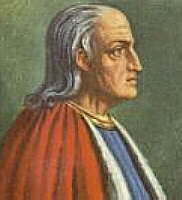
      St. Anselm of Canterbury

      Finished? It is a safe bet that perfection is probably near the top of your list. Well, St. Anselm argued that the very fact that you can imagine perfection proves God's existence? How? He used this rationalist argument:
      1. It is a conceptual truth (or, so to speak, true by definition) that God is a being than which none greater can be imagined (i.e., the greatest possible being that can be imagined).
      2. God exists as an idea in the mind.
      3. A being that exists as an idea in the mind and in reality is, other things being equal, greater than a being that exists only as an idea in the mind.
      4. Thus, if God exists only as an idea in the mind, then we can imagine something that is greater than God (i.e., a greatest possible being that does exist).
      5. But we cannot imagine something that is greater than God (for it is a contradiction to suppose that we can imagine a being greater than the greatest possible being that can be imagined.)
      6. Therefore, God exists.
      (Taken from the Internet Encyclopaedia of Philosophy)

      Below is an excerpt from Anselm's Proslogion:
      CHAPTER II
      That God Truly Exists 
      Therefore, Lord, you who give knowledge of the faith, give me as much knowledge as you know to be fitting for me, because you are as we believe and that which we believe. And indeed we believe you are something greater than which cannot be thought. Or is there no such kind of thing, for "the fool said in his heart, 'there is no God'" (Ps. 13:1, 52:1)? But certainly that same fool, having heard what I just said, "something greater than which cannot be thought," understands what he heard, and what he understands is in his thought, even if he does not think it exists. For it is one thing for something to exist in a person's thought and quite another for the person to think that thing exists. 

      For when a painter thinks ahead to what he will paint, he has that picture in his thought, but he does not yet think it exists, because he has not done it yet. Once he has painted it he has it in his thought and thinks it exists because he has done it. Thus even the fool is compelled to grant that something greater than which cannot be thought exists in thought, because he understands what he hears, and whatever is understood exists in thought. And certainly that greater than which cannot be understood cannot exist only in thought, for if it exists only in thought it could also be thought of as existing in reality as well, which is greater. If, therefore, that than which greater cannot be thought exists in thought alone, then that than which greater cannot be thought turns out to be that than which something greater actually can be thought, but that is obviously impossible. Therefore something than which greater cannot be thought undoubtedly exists both in thought and in reality.


      CHAPTER III
      That God Cannot be Thought Not to Exist 
      In fact, it so undoubtedly exists that it cannot be thought of as not existing. For one can think there exists something that cannot be thought of as not existing, and that would be greater than something which can be thought of as not existing. For if that greater than which cannot be thought can be thought of as not existing, then that greater than which cannot be thought is not that greater than which cannot be thought, which does not make sense. Thus that than which nothing can be thought so undoubtedly exists that it cannot even be thought of as not existing. 

      And you, Lord God, are this being. You exist so undoubtedly, my Lord God, that you cannot even 
      be thought of as not existing. And deservedly, for if some mind could think of something greater 
      than you, that creature would rise above the creator and could pass judgment on the creator, which is absurd. And indeed whatever exists except you alone can be thought of as not existing. You alone of all things most truly exists and thus enjoy existence to the fullest degree of all things, because nothing else exists so undoubtedly, and thus everything else enjoys being in a lesser degree. Why therefore did the fool say in his heart "there is no God," since it is so evident to any rational mind that you above all things exist? Why indeed, except precisely because he is stupid and foolish?

      This text is part of the Internet Medieval Source Book. The Sourcebook is a collection of public domain and copypermitted texts related to medieval and Byzantine history.

      Not convinced? Well, lots of other people weren't either (and more on that later). However, Descartes was. He made the argument more accessible in his Third Meditation contained within his Meditations on First Philosophy. To summarize, God exists for Descartes because if God didn't his entire conception of reality might be false, and God would not do that to someone. If you too have difficulty with this argument, don't worry. Hume felt the same way (more on him below).

       Required Reading
      Click here to read Descartes "Third Meditation: Of God: that He Exists". This is his actual full and monumental works so click it, look at it and further down to the end of this blog entry to will see a link to an outline of Descartes' work.  After reading the meditation, reconstruct Descartes' point-by-point argument proving that God exists using no more than 7 points.

      Godly House Party Manners
      It's rude to go to someone's house party without bringing something (often, but not always, potato salad - that would be an example of a sufficient but not a necessary choice...). So too do philosophers argue that God must have come to the universal picnic with some specific qualities.

      The ontological argument suggests four principal qualities that God must necessarily have in order to be God:
      1. All Powerful (Omnipotent)
      2. All Seeing/Knowing (Omniscient)
      3. All Good
      4. Existence
      Counterarguments
      Q.  As a critical thinker, can you spot any problems with St. Anselm, Descartes and/or others' arguments stated above in explaining the existence of God?
      A.  After pondering the question, click here for some examples that help answer the question.
      Look back at your list of God's Top Five Qualities. Are they similar or different? If similar, why do you think that is? If different, how would you defend your choices?


      A Helpful Resource

      1. Outline of Descartes' Meditation of First Philosophy

      Wednesday, February 12, 2014

      DAY 9 (Feb 13) Critical Thinking Question

      In my absence you are going to work on your first Critical Thinking Question.

      Drawing on yesterday's discussions and your own notes from it and from the blog entries and from these two videos:
      The Case Against Abortion
      Peter Singer on Personhood

      ... answer the following question in two full paragraphs.  You must include quotes/theories from at least four philosophers (look them up) and you must use quotes directly from this article about Dolphins.

      Do you believe that some animals and humans should be granted the same rights?  If so, why?  If not, what rights - if any - should they be granted.  Why?  Use a minimum of four philosophers who would agree and/or disagree with your point of view.

      Please upload your finished work to the same place as your Video Responses (check last Thursday's blog entry for details).


      DAY 8 (Feb 12) Personhood


      Today is all about the Metaphysics Philosophy of Personhood, or being considered a Person.

      First, small group definitions of Person or Personhood:  "What is a Person?"

      Group 1: A Legacy of your family.

      Group 2:  A combination of two parts - private, public.

      Group 3: Collection of meat with a high level of consciousness, personality, and is capable of complex emotions which can also make informed decisions.

      Group 4: Someone who is alive who can think, learn and is self-aware.

      Group 5: A unique personality, emotions, experiences.

      Group 6: Someone who has their own traits, morals and the ability to make independent decisions.

      Group 7: Someone who has the ability to think, feel, grow and learn.


      How to other animals fit into the continuum?


      Orangutan Video  How does seeing this alter your definition of a person?

      Susan Savage-Rumbaugh Video.  How does seeing this alter your definition of a person?

      What is more important to personhood; the mind (consciousness) or matter (brain and body)?  

      List your "Top Five" criteria for personhood.1.  


      Review theories of reality from yesterday's text work.

      Tuesday, February 11, 2014

      DAY 7 (Feb 11) Metaphysics? Reality? Really?

      Why Metaphysics?
      Socrates (469 - 399 BCE) would answer, "The unexamined life is not worth living."

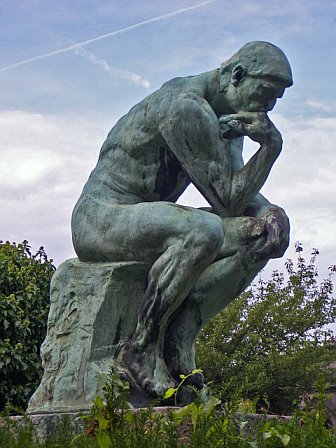
      Each day you are inundated with information - conversations, signs, television shows, Internet blogs, dreams and more. How often do you actually contemplate this information with the intensity of Rodin's famous statue?

      Probably not all that often. But then, with all of the day-to-day demands, who has the time? Indeed, all of this information is sort of like eating nothing but fast food; you may feel full but are you really satisfied?

      Philosophy (which translates to "love of wisdom") is about taking time to consider, critique and reflect on the big questions. These answers do not come easily, nor are there many absolute answers. However, for many philosophers, the journey is more important than the destination.

      So grab a comfy chair and let's take that first step!

      Metaphysics asks these questions . . . . your answers are in purple below each question...
      • What is real?
      Nothing
      Tangible things
      Dreams?
      Consciousness?
      • What is our place in the universe (if, indeed, there is one)?
      Here


      • What are things really made of?
      Mostly nothingness (and of course tiny particles of different kinds of energy)

      • Do we have free will?
      Probably, with exceptions.

      • Who are you?  (i.e. Who Am I?)
      Your DNA
      Experiences
      Prior knowledge
      Memories
      Product of your environment
      Opinions
      Beliefs
      Religion
      Body
      Abilities
      Self-perception
      Interests
      How you process information
      Values
      Morals
      Everything
      Intelligence (multiple facets)
      • Does God exist?
      Some say yes.
      Some say no.

      • Does any of this matter?
      Still wondering.
      Yes.
      No.
      Some of it does.
      • Why?  Why not?
      ???
      • What is the meaning of life?
      It Depends on you.


      So what is Metaphysics? Well, imagine you and your friends are driving in a car for a good old-fashioned road trip. One of your friends might ask, "Where are we going?", while another wonders, "When will we get there?", while yet another cries out, "Who are we meeting later?"

      These are important questions, especially for the driver. But imagine your friends' reactions when you suddenly state, "Is this a dream?"

      Assuming they didn't turn the car around, your friends' answers would be metaphysical.  That is because Metaphysics asks the really big questions.

      As you can see, Metaphysics seeks answer to the same question satirical novelist Douglas Adams answered: what is the answer to life, the universe and everything? However, unlike Adams' tongue-in-cheek answer of
      : the answer to life, the universe and everything, according to Douglas Adams in his series The Hitchhikers Guide to the Galaxy.

      (Adams called this the answer to life, the universe and everything) but few of you new philosophers would agree with him.


      Monday, February 10, 2014

      Day 6, Feb 10 - Metaphysics Videos and the Nature of Reality

      Below is what we did today.  I just read this and wanted to add it to our thinking - CBC report on the recent discover of the oldest known star, 13.7 billion years old, and it's only 6,000 light years from Earth!

      Here is a popular and interesting picture of our current concept of the universe.  Below are several videos to lead our discussion today . . . 


      Here's a link to the Hubble Ultra Deep Field to add to your thinking.


      http://www.youtube.com/watch?v=c8YQE69QsL8

      http://www.youtube.com/watch?v=KcivmBojzVk

      http://www.youtube.com/watch?v=wZ82ATRFVrc

      http://youtu.be/ECJO0eSpBAU

      http://www.youtube.com/watch?v=ZWZEuv6pBIE

      http://www.youtube.com/watch?v=4tbHU04RHrU

      http://www.youtube.com/watch?v=DozI0awtPyg

      http://www.youtube.com/watch?v=iO3YBQa6GHM

      http://www.youtube.com/watch?v=ZWZEuv6pBIE

      http://www.youtube.com/watch?v=KcivmBojzVk

      http://www.youtube.com/watch?v=iO3YBQa6GHM

      http://www.youtube.com/watch?v=peRqNZ4Tpm0

      We also had a good look at that image up there - "History of the Universe".  I would think that we cannot consider fully the state of matter unless we think in terms of "all that is" and that's why we spent some time on that image today!

      Friday, February 7, 2014

      DAY 5 - Video Responses Complete

      As yesterday was a day that I was not here (I was away with the Alpine Racing Team) I understand that there were many questions so . . .  today I'm here and we'll be in Lab 212 to finish your work on these video responses.  Check the previous blog posts for all the details.

      Wednesday, February 5, 2014

      Day 3 Snow Day - So, Day 4 Video Responses

      Please respond to the three videos listed on the blog on Day 1 (Feb 3).

      On Tuesday's blog entry I included a sample response for the Dan Dennett lecture video - use that as your guide about what to include and how much to write.

      You will submit your work to the D2L (Desire to Learn) Online site for this course (HZT).  Go to:

      Online Learning Login   to login.  Your login will be:

      Username -  your usual network login  (e.g.  1KOVICHM  )
      Password - 1234  (that's right, it's 1234 for everyone).

      Do your work in a Google Doc and then upload your work there - you can upload the SHARED Google Doc url of your work too.


      Tuesday, February 4, 2014

      Day 2: Questions Asked and Answered

      1.  Review of yesterday's Dennett video and the big questions it raises.  Below here is a sample answer to the question, "Comment on the video."  See?  Simple question, complex answer.
      2.  We continue with the next two videos (see yesterday's post) and addressed the main points of them.

      Some of the discussion that the "Epistemology" video elicited included these ideas:
      1. We are sometimes willing to lie to ourselves (ignore the actual truth)  to make ourselves feel better (raise our self-esteem).
      2. The only honest job is the magician's - she/he tell you that they will deceive you and they do!

      Some of the discussion that the "Ethics" video elicited included these ideas:
      1. The Greater Good Principle" - when deciding upon the Ethics of an issue, does it matter that a greater number of people will benefit?
      2. Although we all agree that generally it is not right to lie, there just might be situations where lying is the ethical thing to do (would you tell the axe-murder where your parents were enabling him to go an hack them?)
      3. Do ethics apply to other living creatures like genetically modified lab animals, animals used for product testing, etc.?

      Video #1: Dan Dennett: Responding to Pastor Rick Warren

      Dan Dennett’s ideas concerning religion and how we must collectively use the study of it to further societal progress are extremely interesting. He states that instating universal education of world religions is the only suitable practice in an advanced, democratic society that will promote generations with an approach to all faucets of life sans religious intolerance and thus, the skepticism and prejudices nurtured by growing up ardently following one religion. In fact, he suggests that what we know as democracy cannot function properly without such an institution.
      Universal education of world religion is indeed an exciting idea. To me, however, it is less plausible of an idea to instate than is presented in the video. I’m not saying Dennett’s idea is bad, in fact, I agree that in all areas of education, children should receive as much unbiased, factual information as they can. This includes math and English and second/third/fourth languages, in history, geography, current events, law, business, etc. The basis of Dennett’s proposal is to provide student s with FACTS about world religions. But on topics so broad and so very polluted with matters of opinion and contradiction, how is it possible to teach general religious lessons on just the facts? And, how is it possible to mediate a respectful discussion where fact versus interpretation within religion can be dissected without offending anyone, or causing serious ideological conflict?
      Not only is there a huge grey space between what is a fact and what is interpretation when looking at religions, today it is an incredible challenge to make any statements concerning the nature of any one religion without risking the anger of its followers. For an international example, Islamic religion dictates that women should be treated differently men in many ways, such as where each gender is allowed to pray in a mosque (for women it is in the back or basement, out of sight) or how a woman is allowed to present herself in public. When international organizations look into primarily Islamic countries and see gender inequalities it is virtually impossible to help women living in unjust and potentially dangerous situations because the issue at hand involves denouncing the morality of another’s religion. In my mind, the terrible abuse women in many Arab countries live with is not a question of religion at all, but of sexism and misogyny. But what rights do I have which allow me to state what is and is not a fact or an unfair interpretation within Islamic tradition… what right does anyone have to do so?  This argument is firmly established around the world and stands between anyone calling on the morality of religion and the validity of their point, regardless of whether it is something concerning human rights, or another cause.  Even in Canada, our unyielding acceptance for multiculturalism has created such a strong vehemence against anyone that disrupts the principal of universal acceptance and tolerance that debating the ethics of someone’s theological beliefs paints the inquisitor as racist, judgmental and hostile. Thus, in our country, it will be the teachers who administer these lessons Dan Dennett calls for that will face ostracism for presenting certain “facts” about religion and that will certainly make enemies while doing so.
      Regardless, Dennett’s point concerning the function of democracy is valid. Our governmental philosophy cannot work properly if our population is not as educated as is possible. Where religion is concerned, many current events occurring within our own borders could perhaps be understood better by Canadians with a formal, multicultural religious education. With this, when public discussion is raised around issues such as abortion and civil rights such as gay rights, less absolute ideologies would bash against one another and more tolerant discussion and debate could be held – and progress reached. Today when one of these issues is raised, the choice you have is to fall in behind one side or the other – with vigor – or to be labeled as an uncaring or uneducated individual. Dennett’s model proposes that the majority of people religiously educated would be able to see for themselves both sides of the argument and then jump right into problem solving. If we could get rid of the challenges surrounding public discussion and debate over the ethics involved with individual religions and positively educate students on the history and practices of these ancient and revered institutions, then our democratic system would certainly have new potential to flourish and progress.

      Monday, February 3, 2014

      Welcome to Philosophy!!


      1.  Why study philosophy?  Matt Groening, creator of the Simpsons, explains.
      2.  You will need to think outside of the box
      3.  Aristotle in Three Minutes!!
      3.  Ideas, people, events, etc ... the A-Z guide to philosophy.
      4.  Your big questions.

      For tonight and tomorrow at school . . . first of all you will NEED a Gmail account for this course - go and make one for yourself if you don't already have one.  Please make it as close to your first and last name as possible - mine is marktkovich@gmail.com.

      Some assignments will be completed using googledocs (presentation, forms etc).

      Everything else will be submitted through D2L (Desire to Learn) - more on that later.

      HOMEWORK:

      1.  Complete this Contact Information Form .

      2.  Watch these three videos (you can see the text of these talks (subtitles) by clicking the button directly below the video indicating "27 Languages"):

      Metaphysics 
      Epistemology iPod Magic  Epistemology Illusions
      Ethics

      Write your impressions of each video; what you agreed with, what you question, how the main idea(s) fit in your life.  Be prepared to share and hand in your ideas tomorrow.